On April 30, 2025, the Politburo issued Resolution No. 66-NQ/TW on renewing the work of law-making and law enforcement to meet the requirements of national development in the new era. This resolution is part of the so-called “four key pillars” and is of special significance in carrying forward the implementation of one of the three strategic breakthroughs set out in the documents of the 13th National Party Congress. Among these, institutional reform is ranked as the foremost strategic breakthrough, aimed at creating momentum for Viet Nam to enter a new era - an era of development, prosperity and strength for the Vietnamese nation.
Creating a strategic breakthrough in renewing law-making and law-enforcement
Resolution No. 66-NQ/TW sets out clear medium- and long-term goals. By 2025, it seeks to fundamentally address bottlenecks caused by legal regulations; by 2027, to complete a coherent legal framework for the state apparatus operating under a three-tier government model; and by 2028, to perfect the legal system on investment and business, placing Viet Nam’s investment environment among the leading group in ASEAN. Looking towards 2030, Viet Nam aims to establish a democratic, fair, transparent, unified and feasible legal system, laying the foundation for the country to become a modern industrial nation with upper-middle income status. By 2045, the goal is to form a high-quality, modern legal system aligned with international standards and strictly enforced, so that respect for the Constitution and the law becomes a standard of conduct across society.
Resolution No. 66-NQ/TW marks a strategic breakthrough in renewing law-making and law enforcement, serving as a genuine “call to action” for profound institutional reform. It contributes to improving the socialist rule-of-law state in a modern, effective and efficient direction, with people and businesses placed at the centre; it represents a decisive shift from a law-making mindset focused on management to one of development facilitation, thereby accelerating the translation of the Party’s guidelines and policies into law in line with practical requirements.
Minister of Justice Nguyen Hai Ninh stressed that Resolution No. 66-NQ/TW is not merely technical guidance on legal matters, but a revolution in thinking about law and national governance. Its implementation is not a narrow task of the judicial sector alone, but a strategic mission of the entire political system, aimed at building a legal system that effectively serves social development and modern governance.
From an overall perspective, Resolution No. 66-NQ/TW serves as a guiding document for law-making and law enforcement as the country enters a new era of development, with higher requirements for growth quality, national governance, and international integration. The issuance of the Resolution stems from objective practical demands.
Broadly eliminating “bottlenecks” in legal provisions
In 2025, in implementing Resolution No. 66-NQ/TW, with the efforts of the National Assembly, the Government, and ministries, sectors and agencies, the National Assembly (through two regular sittings and one extraordinary sitting) considered and passed a resolution amending and supplementing a number of articles of the 2013 Constitution; and 111 laws and normative resolutions — a record number of draft laws and resolutions. The Government issued 349 decrees and normative resolutions; ministries and sectors drafted, submitted for promulgation, or issued within their authority 1,396 legal documents — the highest in the entire term; and localities issued 13,000 normative legal documents.
This was the largest volume of normative legal documents in the whole term, creating a comprehensive legal corridor for streamlining and re-organising the political system’s apparatus, building and operating the two-tier local government model, advancing de-centralisation and delegation of powers, and reforming administrative procedures. It also helped promptly remove difficulties and obstacles, unlock resources for development, and directly contributed to meeting and exceeding all 15 out of 15 socio-economic targets in 2025.
In particular, the resolution amending and supplementing a number of articles of the 2013 Constitution, the revised Law on the Organisation of Local Government, and the resolution on the rearrangement of provincial-level administrative units in 2025, passed by the National Assembly at its 9th session, were major historical decisions, helping create conditions for the new organisational apparatus nationwide to officially come into operation from July 1, 2025.
Alongside this, the National Assembly issued many special mechanisms and policies in key areas and on emerging issues; promptly institutionalised the Party’s guidelines and resolutions; and focused on removing institutional bottlenecks and reforming administrative procedures. In particular, many difficulties and obstacles in finance, investment, science and technology, innovation and digital transformation, justice, and public order and security have been removed and addressed. Notably, this included the National Assembly’s Resolution No. 197/2025/QH15 on certain special mechanisms and policies to create breakthroughs in law-making and law enforcement.
The spirit of renewed thinking in law-making has continued to be clearly reflected as laws stipulate only matters within the National Assembly’s authority, while granting the Government greater proactivity and flexibility in organising implementation of laws. Thereby, it both ensures the requirements of state management and encourages innovation; unleashes productive forces; unlocks development resources; removes obstacles holding back growth; safeguards people’s lawful rights and interests; and creates favourable conditions for investment, production, and business. It also simplifies the processes and procedures for developing normative legal documents.
It can be seen that the results of implementing Resolution No. 66-NQ/TW have created clear shifts with many breakthrough contents in the building and perfecting institutions and law, meeting the country's development requirements. Thus, the goal set by the Resolution No. 66-NQ/TW– to complete the removal of “bottlenecks” caused by legal regulations in 2025 – has been achieved.
In his speech at the ceremony marking the Viet Nam Law Day, on November 7, National Assembly Chairman Tran Thanh Man affirmed that Resolution 66 embodies the Party's political determination in innovating the work of law-making and enforcement, with new thinking, to create a synchronous, feasible, and transparent legal system. The National Assembly Chairman called on the justice sector at all levels and relevant sectors to effectively implement Party General Secretary To Lam's directions on turning legal institutions into a competitive advantage and define law-making as a “breakthrough of all breakthroughs”; not only overcoming overlaps, contradictions, and bottlenecks but going ahead, paving the way, and leading the country's development.
However, alongside the achievements, building programmes and action plans to implement Resolution No. 66-NQ/TW at several ministries, sectors, and localities has remained slow; the quality of some draft legal normative documents and projects remains limited. There are still cases of delays in issuing detailed regulatory documents to enforce laws and ordinances. Meanwhile, the work of organising law enforcement at some ministries, sectors, localities, and units has not been timely or effective, still lacking an overall design for the legal system suited to the new requirements.
Breakthroughs in institutions, promoting the formation of a digital National Assembly and a digital Government
Among the seven major groups of tasks and solutions, Resolution 66 emphasises: “Strengthening digital transformation and the application of artificial intelligence and big data in the work of law-making and law enforcement.” Accordingly, priority must be given to allocating resources for building and developing information technology infrastructure, large-scale databases, and the application of digital technologies and artificial intelligence to serve the renewal and modernisation of the work of formulating and organising the implementation of laws, ensuring that data are “accurate, sufficient, clean and living”, interconnected, easy to exploit, easy to use, while guaranteeing information security and the protection of state secrets. Timely and adequate funding must be arranged to immediately build and implement the Project on developing a large legal database and the Project on applying artificial intelligence in the drafting, inspection and review of normative legal documents.
The Resolution affirms that digital transformation is one of the key driving forces for improving the effectiveness of law-making and law enforcement, while at the same time meeting the requirements of modern national governance.
In implementing Resolution No. 66-NQ/TW, many stages in the process of drafting, reviewing and formulating normative legal documents have gradually been integrated with modern technological solutions, including artificial intelligence (AI) and the exploitation of open data. The application of these tools enables competent authorities to analyse and assess policy impacts more rapidly, comprehensively and on the basis of richer data sources; at the same time, it helps to identify early contradictions in form, overlaps, duplications or inconsistencies in content among legal provisions. Thereby, it contributes to improving the quality of documents from the drafting stage, limiting the risk of legal conflicts arising during implementation, enhancing the transparency and coherence of the legal system, and promptly meeting the requirements of state management in the context of digital transformation and current socio-economic development.
In the context where normative legal documents are continuously amended and supplemented, causing considerable difficulties for citizens and businesses in accessing new legal regulations, with a series of breakthrough utilities such as legal AI, online feedback and petitions, and rapid document search, the launch of the National Legal Portal opens up a transparent and easily accessible legal space, associated with new thinking and digital transformation, to accompany citizens and businesses in the digital era, towards building and perfecting a digital Government, a digital economy, a digital society and digital citizens.
Chairman of the National Assembly Tran Thanh Man stated that during the last four sessions of the 15th National Assembly, the National Assembly has clearly demonstrated a spirit of innovation in law-making thinking and in the application of science and technology and artificial intelligence. The National Assembly 2.0 application, with many breakthrough improvements and the integration of an AI virtual assistant, has helped the National Assembly pass a large number of laws and resolutions at its sessions.
The thematic conference titled “Digital Literacy for All – Digital National Assembly: A digital knowledge and skill framework for a modern National Assembly”, with the participation of more than 10,000 delegates from the central to local levels in both in-person and online formats, marked a new step forward in the process of modernising the National Assembly. More importantly, it demonstrated strong political determination to place digital transformation at the heart of national governance, creating a foundation to realise the aspiration to build a socialist rule-of-law State of Viet Nam that is “of the people, by the people, and for the people” in the digital era.
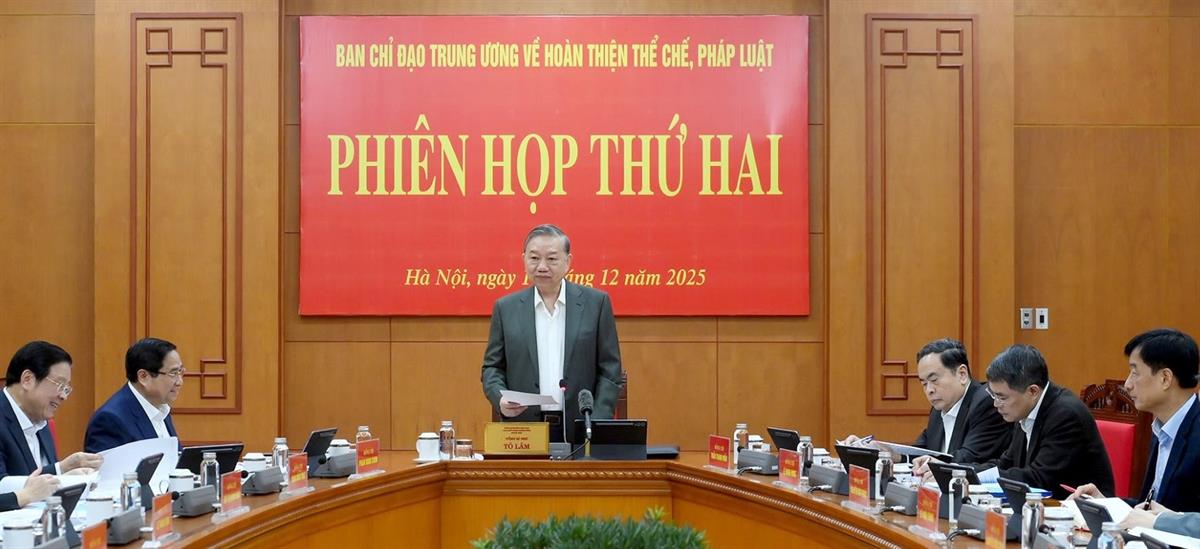
Delivering directive remarks at the second session of the Central Steering Committee on the improvement of institutions and laws on the morning of December 17, General Secretary To Lam affirmed that the implementation result of Resolution No. 66-NQ/TW in recent times has created clear changes, with many breakthrough contents in the work of building and perfecting institutions and laws, meeting the requirements of national development. We have basically completed the target of “by 2025, fundamentally removing ‘bottlenecks’ caused by legal regulations” as specified in Resolution No. 66 of the Politburo. However, the achieved results so far are only an initial step; reality continues to pose new demands, requiring the implementation of Resolution No. 66-NQ/TW to be stronger and more effective.
Emphasising that 2026 is a particularly important year — the first year of implementing the Resolution of the 14th National Party Congress — General Secretary To Lam asked to immediately review and institutionalise the major viewpoints and guidelines in the documents of the 14th Party Congress; the urgent completion of documents to implement the volume of laws and normative resolutions passed at the 10th session of the 15th National Assembly, without delay in guiding documents and conditions for enforcement; focusing on removing as quickly as possible legal “bottlenecks”, difficulties, and obstacles so as not to hinder development; and proactively addressing newly arising recommendations and feedback from practice…
In light of the requirement for rapid and sustainable national development in the coming period, it is clear that the task of building and perfecting institutions still faces many difficulties and challenges. However, with high political determination and the engagement of the entire political system, the spirit of Resolution No. 66-NQ/TW is expected to continue to spread strongly, contributing to building a legal system that is truly a foundation for fast and sustainable development, helping the country enter into an era of strong rising./.